Things I've Done
SPARC '26
Gemma 4 Inference Megakernel
An specialized inference runtime for gemma 4 dense models. The inference engine optimizes for low batch-size on A6000s.
LPT
Built LPT, a latent planning token experiment for language models. It injects planning tokens every n rollouts, then adds their final-layer hidden states to the next n rollouts so future predictions can use a small internal planning signal.
In a matched pretraining run, LPT got 4.6% better perplexity for 0.3% overhead. It is still early evidence, but the mechanism should get more useful with scale.
STRATUS UAV: Optimizing Prescribed Burning using UAVs and Predictive Modeling
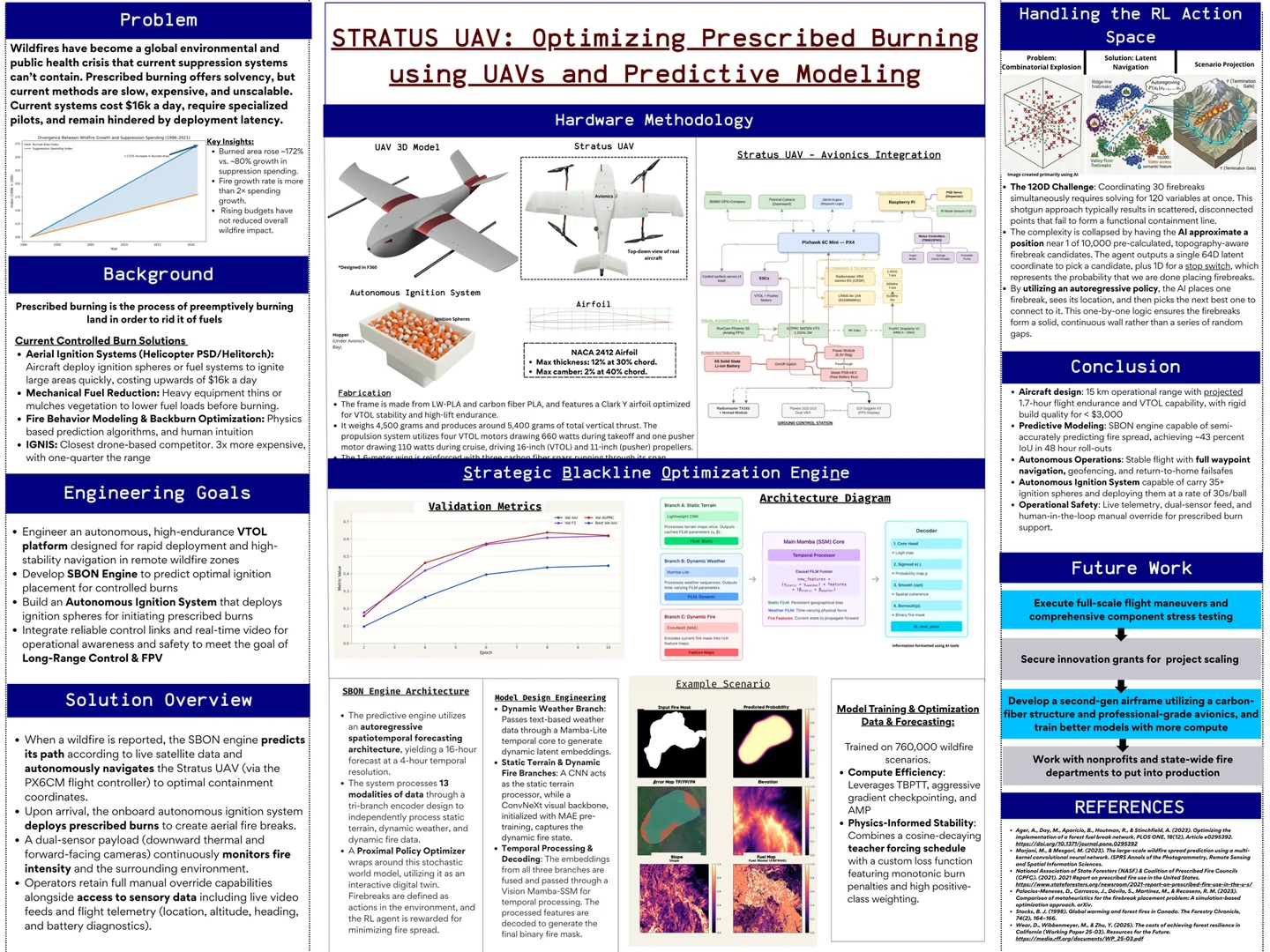
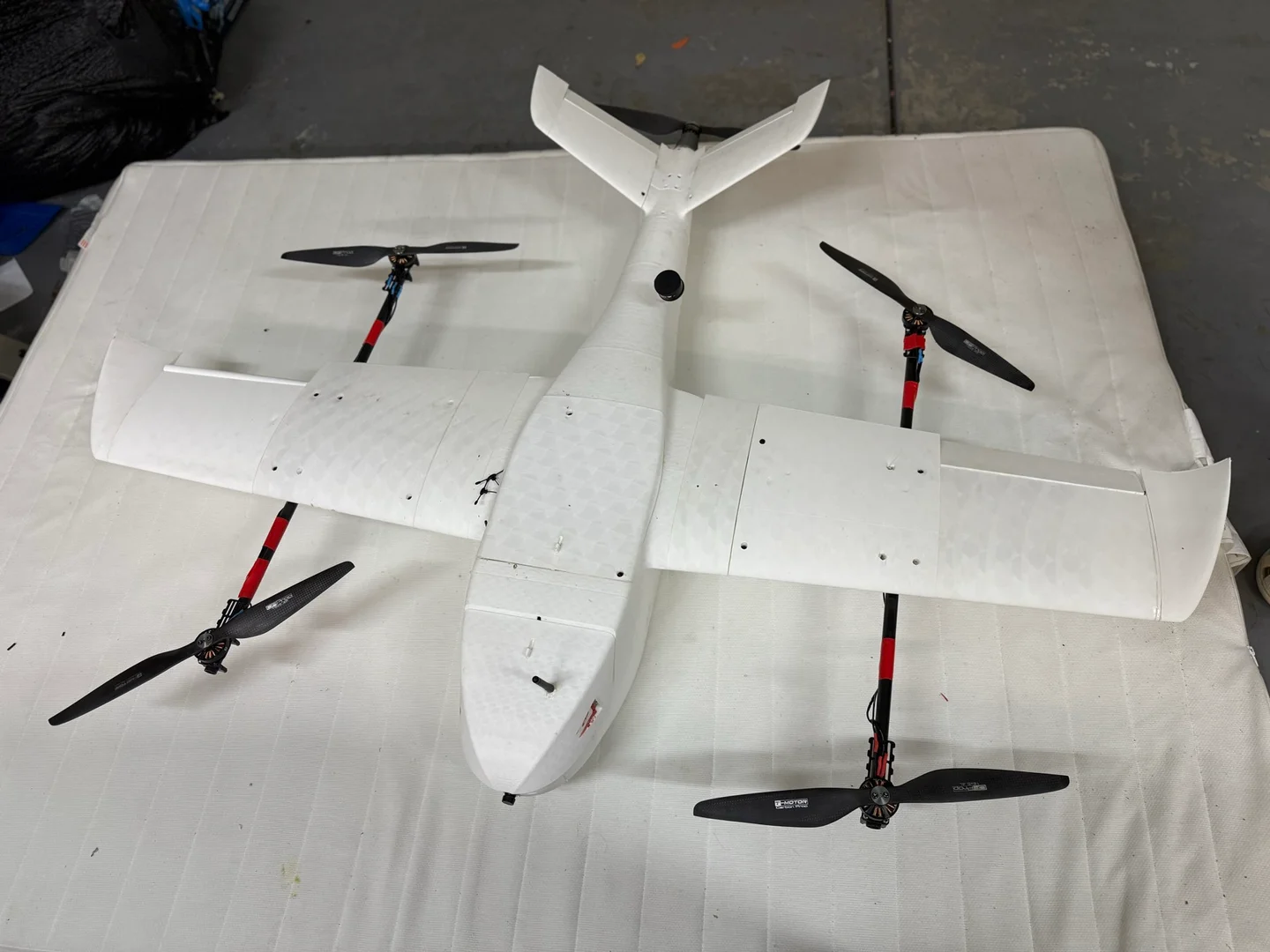
Led development of patent-pending autonomous UAV to mitigate wildfire spread. From scratch, 3D-printed a VTOL aircraft designed to conduct autonomous backburning, achieving 15 km range with 1.2 hour endurance, solving the biggest issues in the field:
- Cost: around $16k/day for helicopters, custom built helicopters, and pilots
- Safety: pilot liability
- Lower price: by 5x
- Higher range: by a factor of 3x over the closest drone competitor
SBON (Strategic-Blackline-Optimization-Engine)
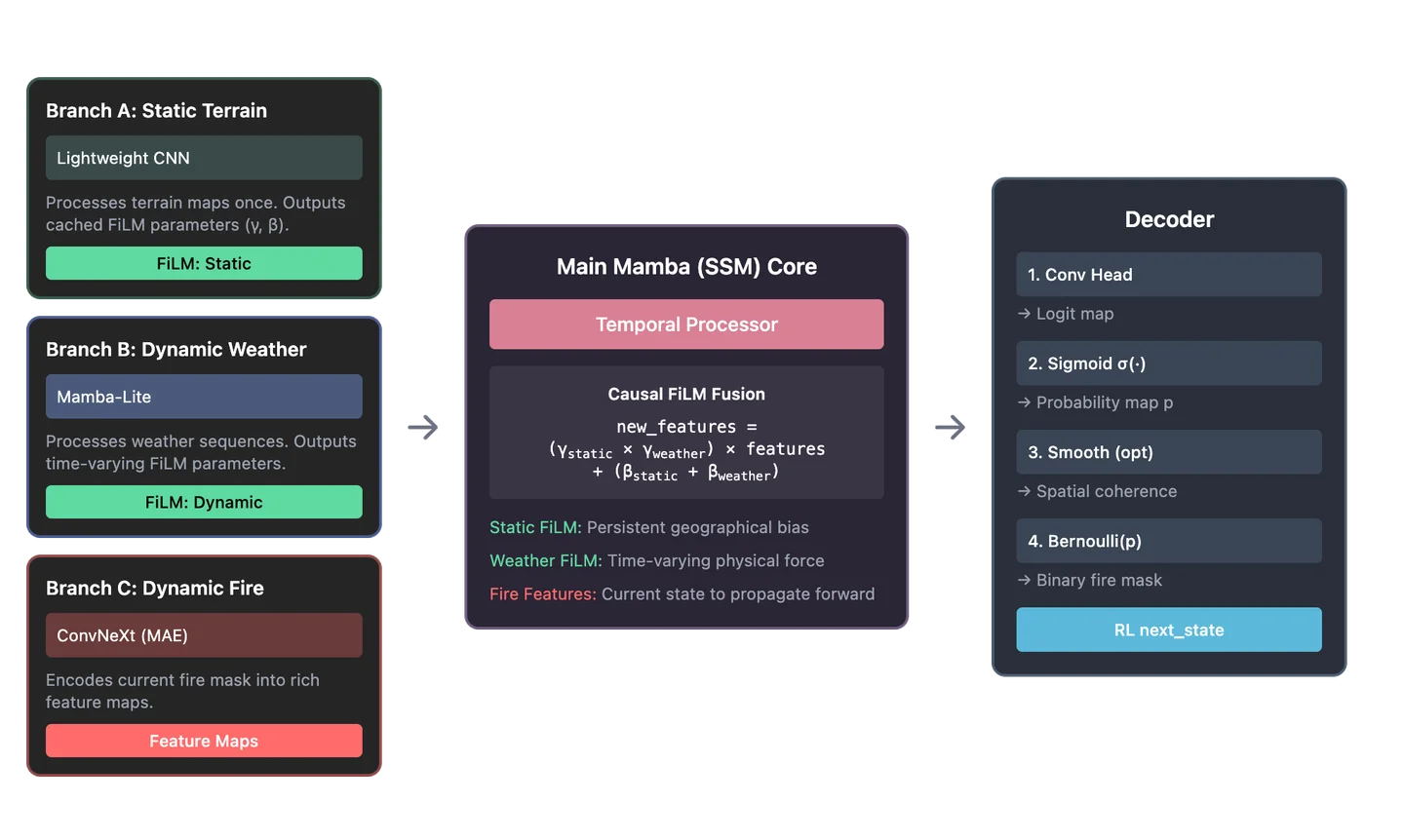
Built a wildfire prediction foundational model that broke SOTA and created the first ML approach to optimizing prescribed burns.
SBON uses a tri-branch multimodal architecture over 13 input modalities spanning fire imagery, weather, and geography, with ConvNeXt and SSMs as encoders, feeding into a larger SSM to create a 4-hour fire-mask prediction.
We treat the wildfire foundational model as an environment, where we autoregressively rollout to 48 hours to get a longer scale prediction. We then use PPO to optimize the placement of prescribed burns, turning a workflow still driven largely by checklists and operator intuition into an optimization problem.
Optimizing prescribed burns is unfortunately niche with < 20 papers in the last 30 yrs. Mine hit SOTA as the first deep learning approach to it.
No Circles
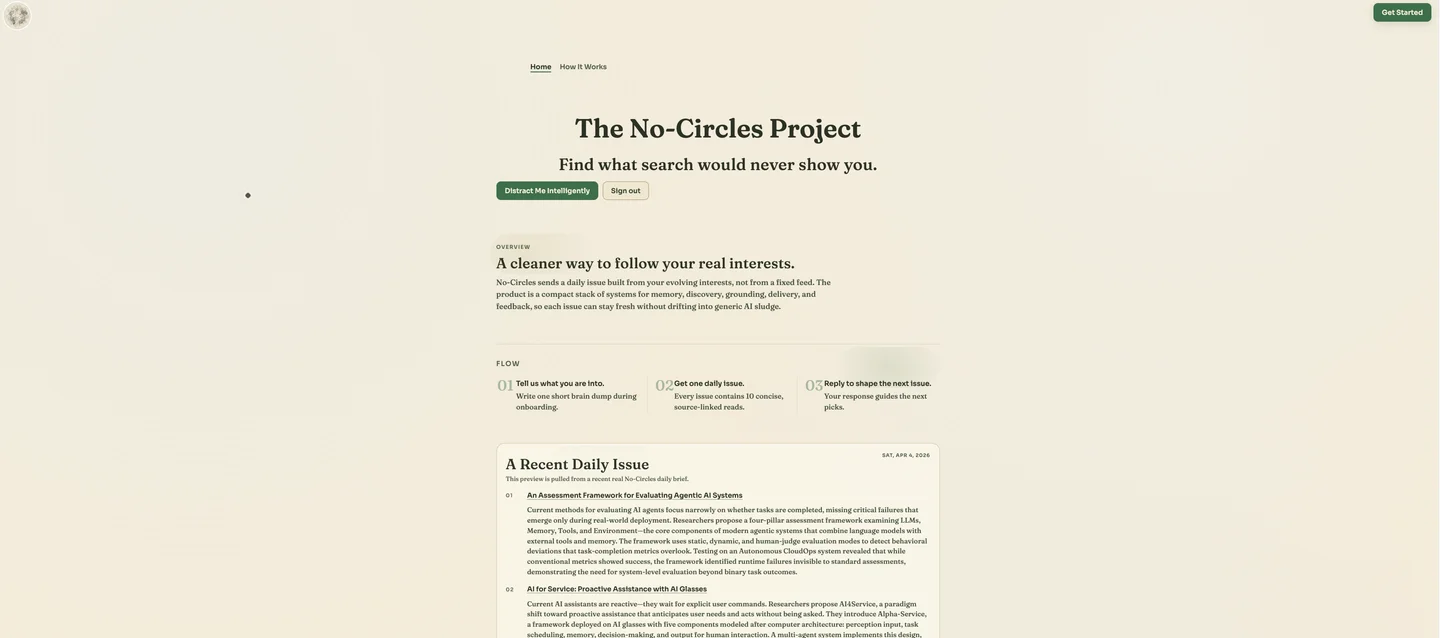
Built no-circles.com, a website-first personalized daily newsletter that learns from what each reader actually responds to.
The system keeps a memory of the user, builds a brief from that memory, and updates future issues from replies and feedback to help teach the person about tangential fields they know little about. Scaled to triple-digit users 3 weeks from inception
Science fair results
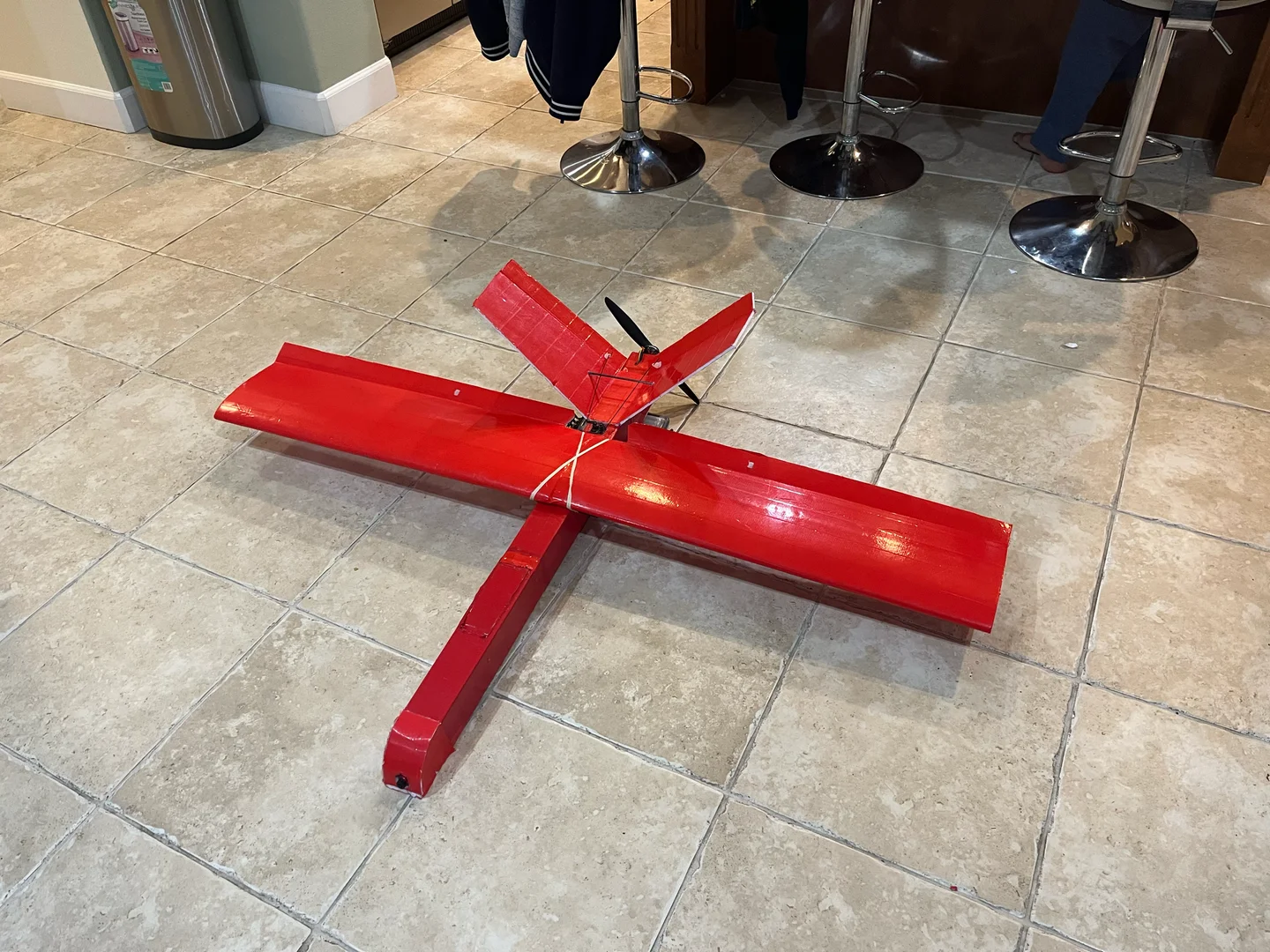
Placed 2nd in the California State Science Fair, 1st @ regionals and won 5 awards building PHOENIX UAV for early wildfire detection:
1st in category, 1st in fair, Henkel aerospace award, 1 of 3 selected for national competition, 1 out of 200 nationally winning Junior Lemelson-MIT Inventor Award, and 1 of 20 selected for state level competition.
Competitions
Competed in various competitive programming and physics competitions, ultimately developing skills achieving USACO Gold and qualifying scores on the F=MA exam, which is top 5% nationally.
I also competed in CALICO, Harker Physics Invitational, Harker Programming Invitational, and held a top 30 placement in the nation in MSPF Debate, reaching elimination rounds in national-circuit tournaments like Stanford and TOC.
Self-study
Independently studied mathematics from high school precalculus to multivariable calculus and linear algebra, as well as ML and transformer theory, in under a year.